


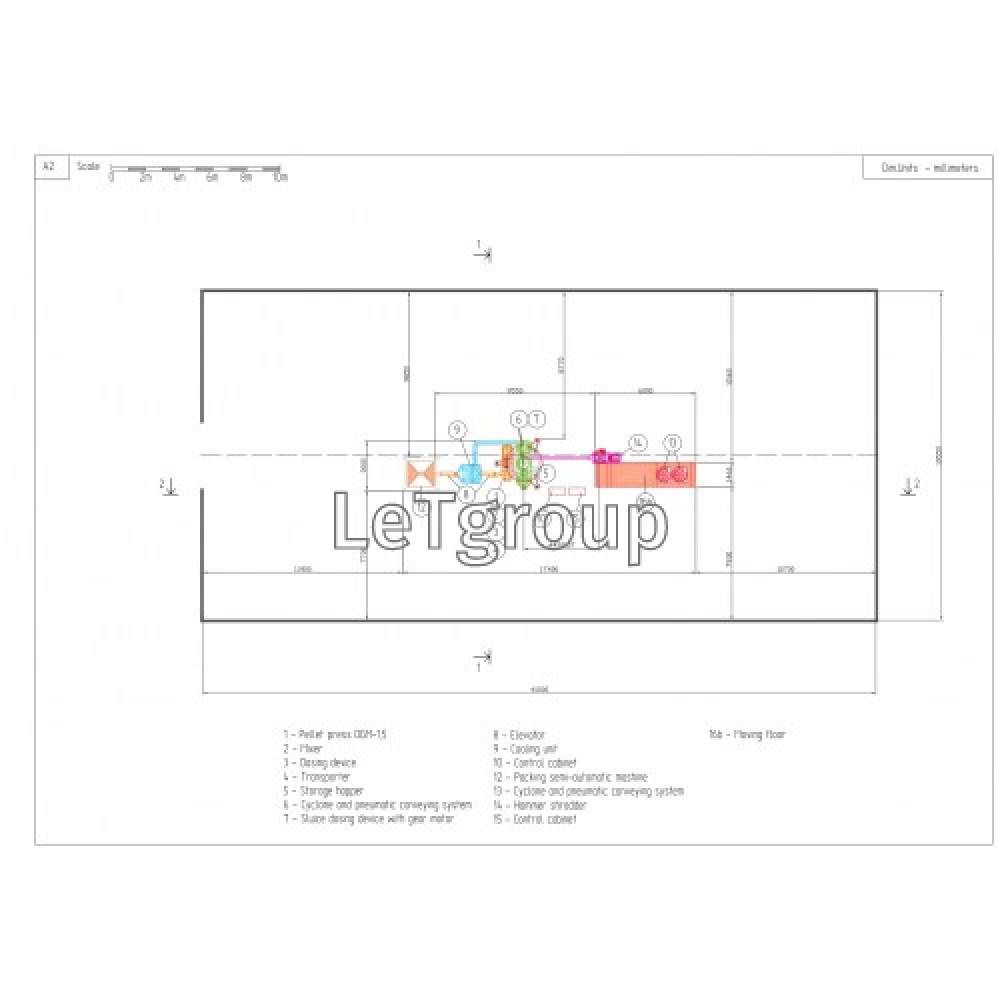
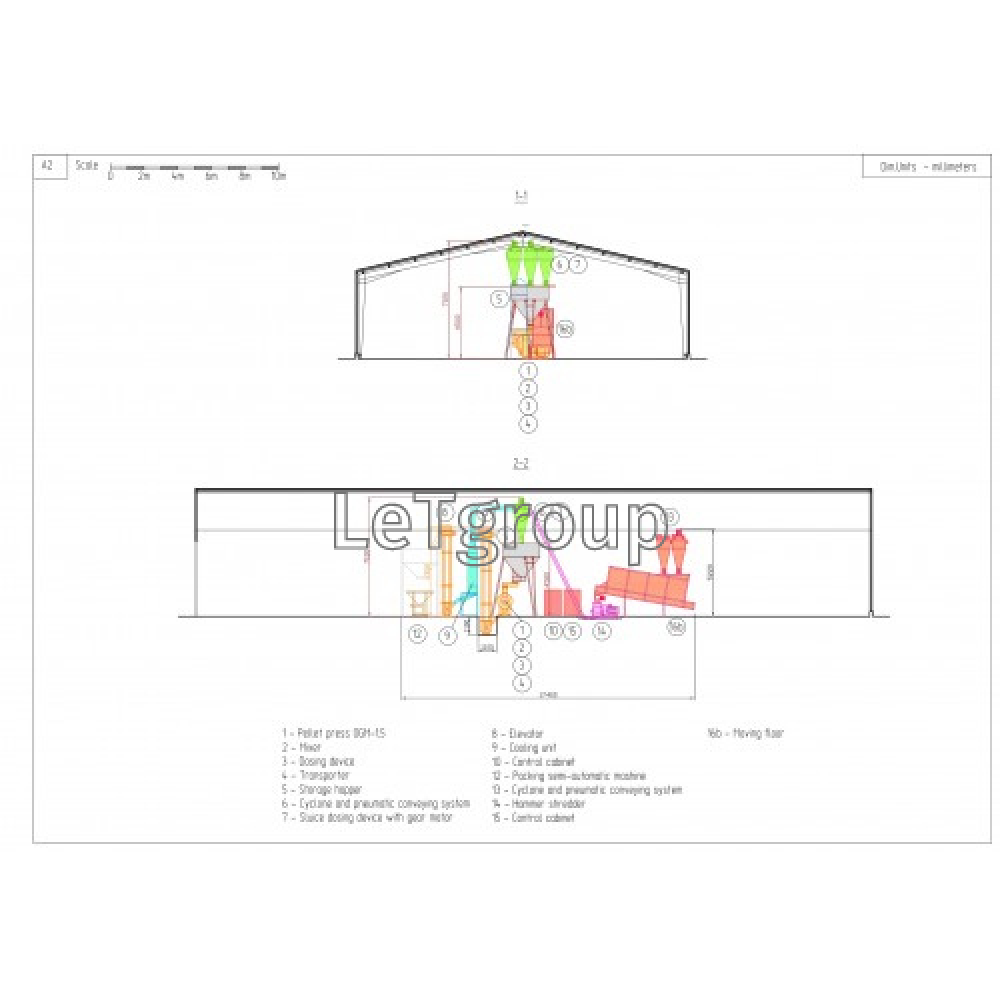


OGM-1.5 pellet/feed production line 106 kW
Ex Tax: 300 000 zł
Inc Tax: 369 000 zł
 The OGM-1.5 pelleting line from LabEcoTech processes renewable raw materials such as sawdust, wood chips, sunflower husks, waste from corn and cereal production, straw and other biomass into pellets of high efficiency and quality. They are further used in micro-constructions, in housing estate boiler houses, in cogeneration systems to supply heat and electricity to municipal services, to heat private houses and in high-power pellet boilers.
Wood waste is not just thrown away. By installing the necessary equipment for their processing, they can be recovered and bring profits sufficient for a short period of time - one heating season. According to experts, the return on investment in pellet production lines is 7-8 months.
☉ Capacity depends on granular material and die diameter.
Fuel pellets produced using modern equipment on these lines meet EU standards. The diameter of the produced pellet (granulate) is 6-8 mm (depending on the diameter of the die holes installed in the press granulator). The length of the pellets is 10 - 50 mm. Density is 1.1 - 1.2 kg / dm3, specific gravity 650 - 700 kg / m³ The capacity of the line with one OGM 1.5 granulator is 1 ton/hour. If two press granulators are installed, the capacity is actually doubled, which allows regular maintenance of one of the press granulators without having to stop the entire production.
What is the secret of the popularity of fuel pellet production?
It's all obvious. Apart from the fact that it is profitable enough, there are a few key points:
☉Raw material costs are low because pellets are made from production waste;
☉The calorific value of pellets is 4.0-4.5 kWh/kg, which is higher than the calorific value of wood
☉ They have a low ash content, below 1.1%;
☉ Pellets are one of the most environmentally friendly fuels; do not contain chemical impurities and sulfur in the combustion products, so the emission of harmful substances into the atmosphere is minimal;
☉In the case of pellet combustion in special pellet dispensers, the efficiency reaches 93%;
☉ Pellets have an unlimited shelf life, do not deteriorate over the years and do not require special storage conditions;
☉ Pellets are small and hard, they can be packed in containers (bags) from 10 kg to 1000 kg;
☉ Automatic boilers of various power are used to generate heat from pellets, which eliminates the need for constant human presence;
The equipment configuration of the fuel pellet (pellet) production line is determined at the design stage, and technical solutions are prepared by qualified experts with many years of experience in designing, assembling and commissioning fuel pellet granulation lines. Depending on the customer's decision, a list of devices is selected, taking into account the production conditions and the required capacity.
Changes are made by two people.
2.5-3.5 m3 of raw material is used to obtain 1 ton of product.
The principle of operation consists in:
1) The raw material prepared for granulation is fed by a screw conveyor to the hopper, from where the raw material is evenly fed to the mixer, where it is moistened with water or steam to the required granulation humidity and intensively mixed in the mixer (moisture contributes to the formation of stable granules).
2) From the mixer, the wetted raw material is discharged through a ferromagnetic impurity separator to the press. In the press chamber, the raw material is drawn between the rotating die and rollers and forced into the radial openings of the die, where pellets are formed under high pressure.
3) The granules squeezed out of the holes fall onto and are released by the attached knives. The length of the crushed granules can be adjusted by rotating the knife on its axis. The crushed granules fall and are removed from the press through the casing sleeve.
4) The blades feeding the raw material on the rolls can be triangular (feeding only half of the product layer under the roller) or rectangular (feeding the rest of the product under the second roller), and the position of the blades and rollers must be maintained when disassembling the press.
5) The pellet coming out of the press is hot and brittle and is transported by elevator to the cold room. The fan forces air into the bed of pellets to cool it, and at the same time sucks some of the unsorted material into the cyclone. During cooling, the evaporation of water reduces the moisture content of the granules and causes physical and chemical changes in the granules. As a result, the required hardness, humidity and temperature are obtained.
6) From the cold store, after filling, the granules are sorted,
- Press 1 pcs
- Screw conveyor 1 pcs
- Hopper 1 pcs
- Cooler - sorting 1 pcs
- Cyclone with fan 1 pcs
- Vertical (bucket) feeder 1 pcs
- Water injection system 1 pcs
- Electric cabinet 1 pcs
- Reducer frame 1pcs
- Mixer 1pcs
- Dispenser 1pcs
- Instruction manual 1pcs